


The “Total cashback” value shown on the Carbon Cashback dashboard is only available if the property reduces its energy consumption by more than a specific target set for its council tax band.
Reductions must exceed those expected from behavioural changes and smaller improvements like loft insulation. Several smaller upgrades or one substantial upgrade, such as a heat pump, will usually be needed to pass the benchmark.
Energy use is measured from when improvements are installed until savings are verified and carbon credits are applied for. The benchmark does not need to be beaten every day, but it must be exceeded for the monitored period when checked prior to verification. If the home does not meet the benchmark at that point, the cash amount shown on the dashboard will not be paid.
We're excited to launch the Carbon Cashback beta platform. The beta label is displayed to show the platform is in its testing phase - this means you are among the first to try it out before full release. It may not work perfectly for everyone and you may not be able to enrol depending on your individual circumstances for now.
Please try out the platform, let us know what you think, and share any suggestions you may have for improvement - we are listening!
Yes. It doesn't cost you anything to enrol or to connect your smart meter.
Snugg charges an administration fee following the sale of credits, which cover costs of verification, awarding credits, identifying buyers and the payment process.
If you're thinking of installing any energy efficient improvements to your home, then it's worth enrolling. Without any effort from you, your Smart Meter will track energy reduction and you'll be banking carbon credits. The more you install, the more you'll earn each year.
It's wise to enrol early as you'll need at least a year's worth of home energy data before an installation, so that a comparison can be made.
You can enrol after an improvement has been installed, as long as we can still access a full year of your smart meter data from before the installation. We compare your energy use before and after, so your Carbon Cashback can be verified properly.
After about four weeks from your installation date, we won't be able to access the data we need, so it's worth signing up as soon as you can.
One common concern about Carbon Cashback is that it supports greenwashing, letting companies claim they've done more for the environment than they have. At Snugg, we make sure all the companies we sell to are proactively addressing their own emissions before they buy and retire carbon credits.
Carbon credits were originally set up by the UN to support climate action with the help of private finance, by letting companies buy carbon credits. In fact, a recent industry report found that companies that buy carbon credits in the voluntary market are doing more to tackle their emissions than companies that don't.
We are the first company to leverage smart meter data to generate carbon credits for homeowners.
Our credits are generated through Verra's VCS program. Verra is the single largest carbon credit certifier in the world.
Energy efficiency credits have previously been very difficult to create owing to the data required to make the robust and credible. Snugg has changed this by leveraging smart meter data to make the process seamless for homeowners, and more robust than it has ever been before.
How much you earn depends on the amount of energy you save that year and the market rate for a Credit, which changes constantly.
As of February 2025, they're worth about £78 for each tonne of CO2 saved - one Carbon Credit. As an example, if you installed double glazing and insulation, you might reduce your energy use by 1.5t of Carbon.
Each year, that could be £117. Over 10 years, that might be worth £1,170. Keep in mind that the value changes each year based upon demand, however.
Keeping your data safe and secure is important to us. We'll never sell your data, and we'll only share it with our partners so they can verify your carbon credits.
We need to make sure the credits we generate are genuine emission reductions, so we're audited by an independent third party every time we ask for credits to be issued. We only share your data with our auditor if your home is chosen as part of the audit.
Read more in our Privacy Notice.
We're a small team based in Edinburgh, helping homeowners make smarter home energy improvements and save money.
We focus on the changes that can make the biggest difference to your bills, like solar panels, home batteries, heat pumps and electric vehicles, and on helping you pay for them.
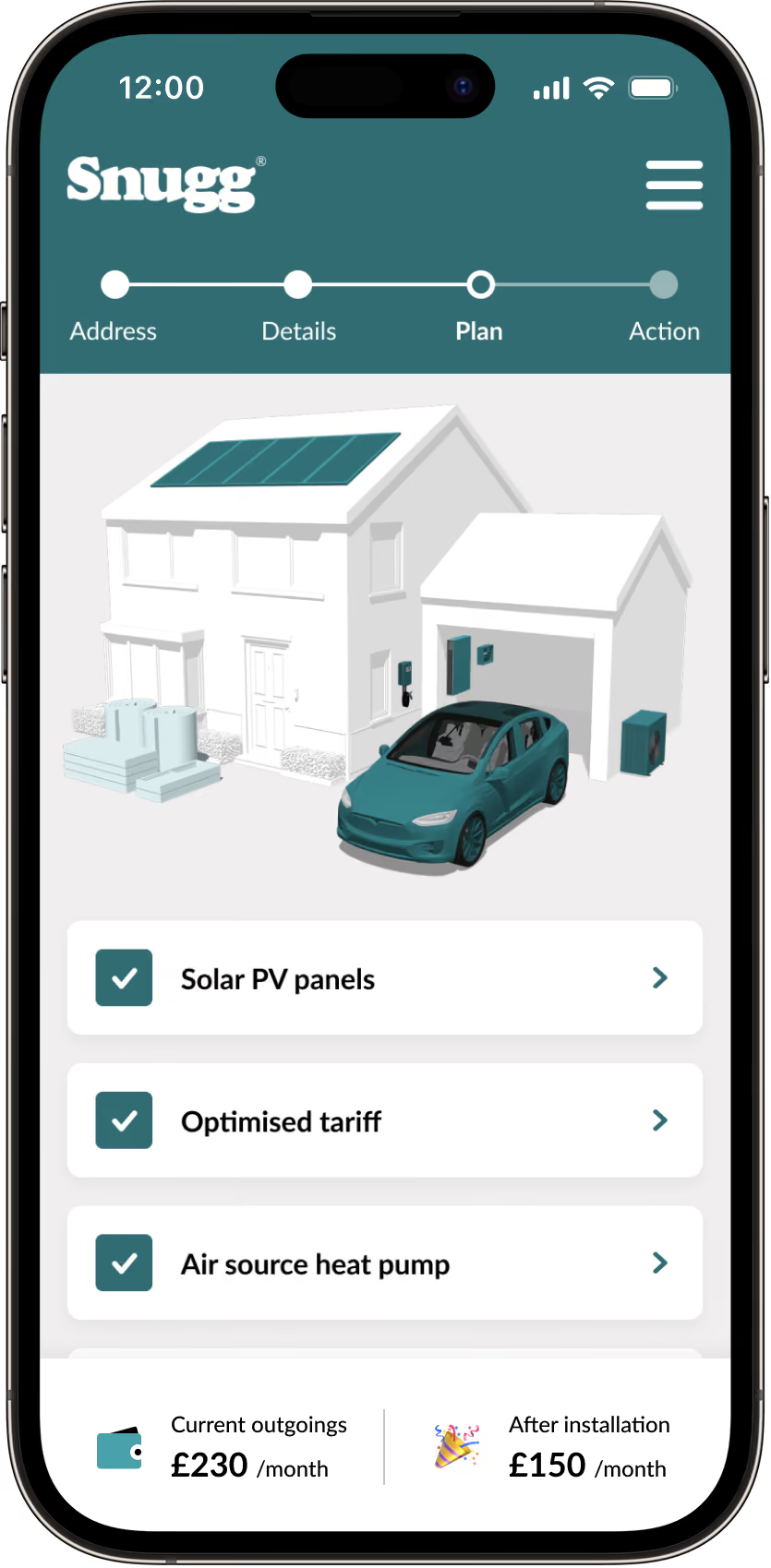
Snugg is an online platform that shows you how improvements like solar panels, a home battery, a heat pump or an electric vehicle would change your energy bills.
It's based on your home's real energy usage and tariff. You can try different combinations, see the grants and finance you could use and, when you're ready, find installers you can trust.
Our mission is to put your home on a clearer, more efficient path to saving money.
Working out which improvements are worth it, what order to do them in and how to pay for them can be confusing. Snugg brings it all together in one place.
You'll see how each improvement would change your bills, based on how your home uses energy, along with the grants, finance and trusted installers available to you.
Go at your own pace, with nothing hidden and nothing forced.
It depends on your home, how you use energy and which improvements you choose. Snugg shows you how each improvement would change your monthly energy bills, and what you'd pay each month once any grants or finance are included. So you can see the real difference to your household budget, not just the price of the improvement. You can add or remove improvements and see the change straight away. Some of our installation partners also offer discounts to people who come through Snugg, which could bring down the cost of an install.
The time it takes for an improvement to pay for itself is often called its payback period. It depends on what the improvement costs to install, how much it saves you each year and any grants or finance you use. For example, if an improvement costs £6,000 and saves you £600 a year, it would pay for itself in 10 years. Energy prices, your tariff and how you use energy all make a difference, and some improvements pay back faster when they're combined, like solar panels with a battery.
Give us a few details about your home to get started, and you can change them at any time. Then we work out how each improvement, on its own and alongside others, would change your bills, half hour by half hour, across a whole year. We use a range of current tariffs, which we review regularly to keep up with the market. And if you connect your smart meter, we use your home's actual energy usage as the starting point instead of an estimate.
We work with banks, building societies, energy companies and consumer organisations, who pay to offer Snugg to their customers. Some installers and finance providers may pay us a referral fee if you choose to go ahead with them. You never pay us anything.
Yes, Snugg is free for homeowners. Our partners pay us to offer Snugg to their customers. Some installers and finance providers may also pay us a referral fee if you go ahead with them, but that doesn't change the price you pay.
No, we don't pay for improvements or lend money ourselves. But Snugg shows you the grants and loans you could be eligible for, along with other finance options, and builds them into your costs so you can see what you'd actually pay.
Snugg is built for UK homeowners who want to cut their energy bills and make improvements in stages, like adding solar panels, a home battery, a heat pump or an electric vehicle charger. If you rent, you'll usually need your landlord's permission before making changes like these. If you pay your own energy bills, you may still be able to switch to a cheaper tariff.
No, but when you're ready, we'll point you to installers you can trust. You decide whether to use them.
We only collect the personal data we need to give you your savings and recommendations, like your email address and details about your property. We encrypt your data when it's sent and when it's stored in our secure cloud database on AWS, and we never sell it. You can opt out of tracking at any time. Read more in our Privacy Notice.
We're committed to providing you with a secure online experience. So we've built our website using industry-leading technology that meets industry standards. This includes encrypting all traffic with SSL for maximum security. We also take great care to protect your personal data, which we store and encrypt within the cloud using AWS. Our infrastructure is cloud-native. This allows our development team to leverage the unparalleled scale and flexibility of the cloud. It also allows our users to benefit from an enterprise-grade network architecture that's specifically designed to protect their data. With Snugg, you can rest assured that your privacy and security are our top priorities.
Snugg was founded in January 2022 by Robin Peters (CEO) and Neil Svensen.
Today we're a team of around 15 people, with experience across energy, financial services, home retrofit and technology.
If you're interested in joining us, check for open vacancies on our About page.
Email us at hello@snugg.com, or find us on Facebook, Instagram, X and LinkedIn.
Our head office is in the Bayes Centre at the University of Edinburgh. The Bayes Centre is the university's hub for AI and data science innovation, and home to many technology and data companies.
We hope you enjoy using Snugg. If you have a complaint, email us at hello@snugg.com.
We take all feedback seriously and will do our best to sort out any issue as quickly and thoroughly as we can.
You can also ask for a copy of our complaints procedure at the same address.
You don't need your EPC to use Snugg. If you'd like to see your home's report, you'll find it on the GOV.UK EPC register for homes in England, Wales and Northern Ireland, or the Scottish EPC Register for homes in Scotland.
Start by giving us a few details about your home. Then choose the improvements you're interested in, like solar panels, a battery or a heat pump, and Snugg shows you how each one would change your energy bills, including any grants or finance you could use.
Add or remove improvements and your costs and savings update straight away. You can also connect your smart meter, so your savings are based on how your home actually uses energy.
When you've found a combination that works for you, we'll help you take the next step.
It depends on the improvement and whether any work is needed first, and your installer will give you an estimate before they start.
As a rough guide, solar panels can be installed in as little as a day and a home battery usually takes around a day. An air source heat pump usually takes a few days.
Find out more about each improvement on the Snugg blog.