
Snugg is a fast-growing Scottish startup committed to making home energy efficiency simple and affordable for everyone. We’re helping UK homeowners reduce their carbon footprint and save on bills—one home at a time.
A home battery stores electricity so you can use it later, whether that's solar power you've generated during the day or cheap electricity bought overnight on a smart tariff. Pair it with solar and you could use far more of the power you generate yourself, instead of exporting it back to the grid for a fraction of the price. This guide covers how home batteries work, what they cost, and whether one is worth it for your home.
In this guide, we cover:
- What is a home battery?
- How does home battery storage work?
- What types of home batteries are there?
- What are the benefits of home battery storage?
- How much does a home battery cost?
- Can you get a home battery without solar panels?
- How does Snugg help you add a battery to your home?
- Home battery FAQs
What is a home battery?
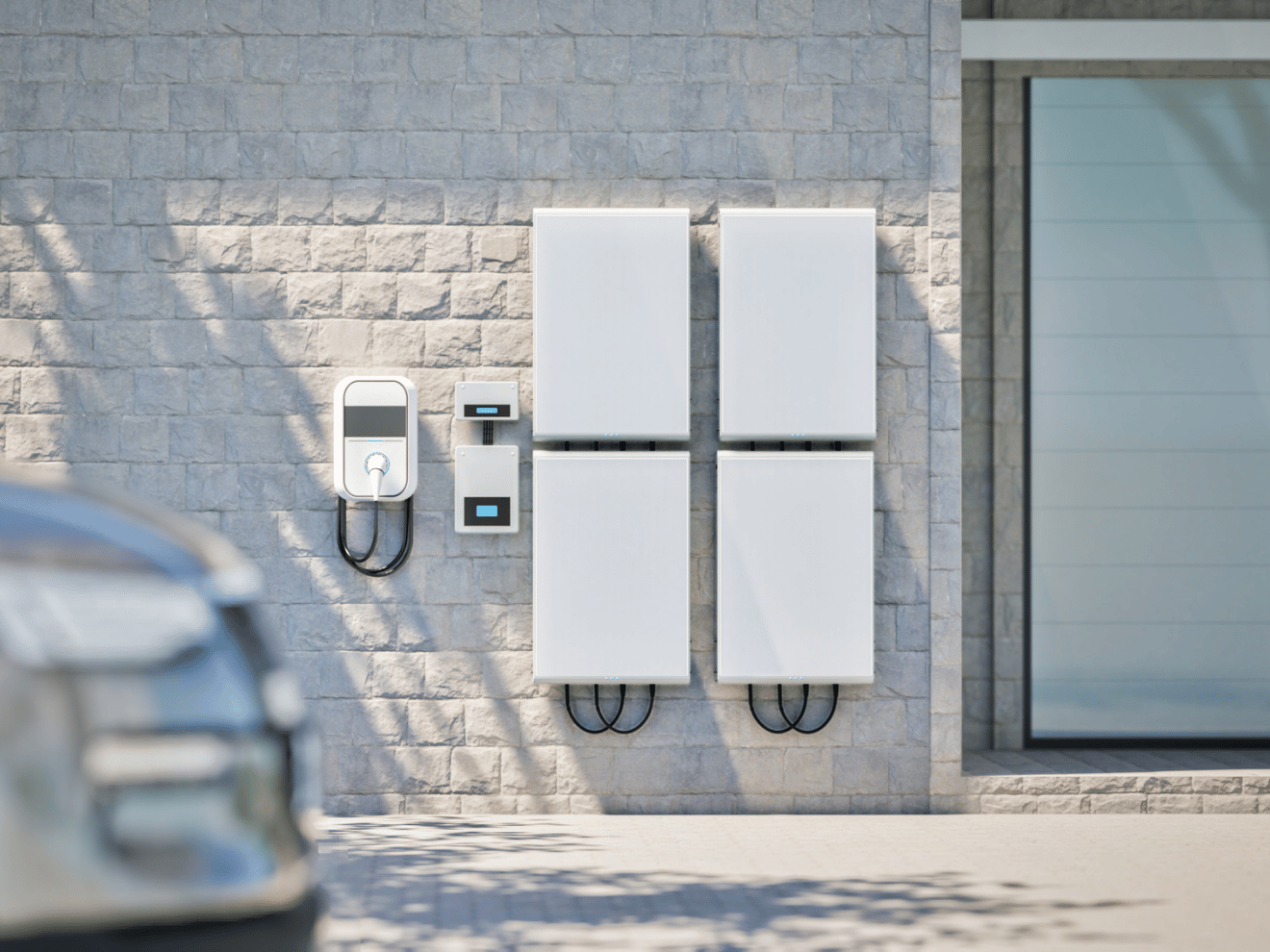
A home battery is a device installed in your home that stores electricity for you to use later, rather than using it straight away or sending it back to the grid. It's most commonly paired with solar panels, storing the power your panels generate during daylight hours so you can use it in the evening, when you're likely using more electricity but generating none.
Batteries can also be charged directly from the grid, typically overnight on a cheap rate, and then used during the day. This is a useful option even for homes without solar panels, provided you're on a tariff with a meaningful gap between peak and off-peak pricing.
How does home battery storage work?
At its simplest, a home battery sits between your electricity supply, whether that's solar panels, the grid, or both, and your home's electrical system. When there's more electricity available than your home needs, such as solar generation on a sunny afternoon or a cheap overnight rate, the battery charges up. When you need more electricity than is being generated or bought cheaply, the battery discharges to cover the gap, drawing on the grid only once the battery is empty.
Most home batteries are managed automatically by a smart system that learns your household's usage pattern and adjusts when the battery charges and discharges to get the most value. Its priority is making sure you have enough stored to cover the expensive evening peak. So, if it's better value to charge from the grid than to wait for solar, it will. And when the grid has more electricity than it needs and prices drop, the system may run your home on cheap grid power and send your solar generation to the battery instead. You don't need to manage any of this yourself.
What types of home batteries are there?
AC coupled batteries
These connect to your home's existing electrical system independently of your solar panels, using their own inverter. This makes them straightforward to retrofit alongside an existing solar setup, since they don't need to interact directly with your existing solar inverter.
DC coupled batteries
These connect directly to your solar panels, sharing an inverter with the solar system. This is more efficient, since electricity is converted between AC and DC fewer times, DC coupled batteries are best installed at the same time as your solar panels, as adding one to an existing system can mean replacing your solar inverter.
Retrofit versus solar paired installations
If you already have solar panels, adding a battery afterwards, known as a retrofit, is common and increasingly straightforward, though it's worth checking compatibility with your existing solar inverter. If you're installing solar and a battery together from scratch, a DC coupled system is often the more efficient choice, since it can be designed as one system from the start.
What are the benefits of home battery storage?
- Using more of your own solar generation. Without a battery, any solar power you don't use immediately is exported to the grid, usually at a lower rate than you'd pay to buy electricity back later. A battery lets you store that power and use it yourself instead.
- Lower bills through cheaper overnight charging. Even without solar, a battery paired with a smart tariff lets you buy electricity at a lower off-peak rate overnight and use it during the day and evening, when rates are higher.
- Backup power during an outage. Some battery systems can provide backup power to your home if the grid goes down, though this depends on the specific system and how it's installed. Not all setups include this by default, so it's worth checking if it matters to you.
- Getting more value from a smart tariff or an EV. A battery, an EV and a smart tariff all work together. Charging the battery and the EV on a cheap overnight rate, then drawing on stored power during the day, makes the most of switching to a time of use tariff in the first place. If you have solar panels too, you can go a step further: charge your battery overnight on the cheap rate, then export your daytime solar generation to the grid. On many tariffs, the rate you're paid for exporting is higher than the rate you pay to charge overnight, so your solar earns more than it costs to fill your battery.
- A step forward but it does reduce how much you rely on buying electricity at peak, expensive times.
- Greater energy independence. No home battery makes you entirely independent of the grid, but it means you rely on it less.
How much does a home battery cost?
Costs vary considerably depending on the battery capacity, whether it's installed alongside new solar panels or retrofitted to an existing system, and how complex the installation is. Larger batteries can store more electricity and cover a bigger share of your evening usage, but they cost more upfront and can deliver greater long-term savings if your usage and solar generation justify the extra capacity.
As with solar panels, the right size of battery depends entirely on your household's usage pattern. A bigger battery isn't automatically better if your usage doesn't need that much storage. This is exactly the kind of calculation that's hard to get right without knowing your own home's numbers, which is why a personalised estimate is worth more than a generic price range.
Can you get a home battery without solar panels?
Yes. While batteries are most commonly discussed alongside solar panels, they don't need them. A battery can be charged directly from the grid on a cheap overnight rate then power your home through the day and the evening peak, when electricity costs the most. This kind of load shifting can deliver worthwhile savings, even without any solar generation feeding into it.
Solar panels are the most familiar partner for a battery, since you're storing electricity you've generated for free. But the Energy Saving Trust have found that, on the right tariff, batteries are an even better match for heat pumps. The battery charges on cheap off-peak electricity, then runs your heat pump through the pricier parts of the day, so you can keep your home warm without paying peak rates.
Whatever you pair it with, the tariff is what makes a battery pay. The cheapest overnight rates tend to come with tariffs designed for homes with an EV, heat pump or solar panels. So, a battery on its own has fewer tariff options, and without a cheap rate to charge from, you could end up filling it with standard or peak-rate electricity. That's why a battery works best as part of a wider plan, alongside other upgrades, rather than a standalone purchase.
How does Snugg help you add a battery to your home?
The Snugg platform shows you how a home battery would work alongside anything else already in your plan, whether that's solar, an EV or a smart tariff, so you can see how much it could save you before you commit, not just how much it costs. Rather than looking at a battery in isolation, we look at how it interacts with the rest of your home's setup, since the real value of a battery comes from how well it's matched to your other improvements, not from the battery alone. We'll also suggest the right battery size, based on your home's size and estimated energy use. Connect your smart meter and we can base this on your actual usage pattern, for an even more accurate estimate.
_________________________________________________________________
Get started with Snugg and start saving on your energy bills.
Check grants, find trusted installers and work out the best way to pay, so you can start saving on your energy bills.


Home battery storage FAQs
No. A battery can charge from the grid on a cheap overnight rate and power your home through the evening peak. It works best alongside an EV, heat pump or solar panels, which give you access to the tariffs with the cheapest overnight rates.
Home batteries are generally designed for many years of regular use, though lifespan depends on the specific product, how it's used, and how it's maintained. It's worth checking the manufacturer's warranty for a specific system.
This depends on your household's electricity usage and, if you have them, how much your solar panels generate. A bigger battery isn't automatically better. It should match what your home actually needs. Snugg suggests a battery size based on your home, and if you connect your smart meter, we can base it on your actual usage.
Some systems offer backup power during an outage, but not all do by default, and it varies by product and installation. Check this specifically if it matters to you, rather than assuming it's included.
Grant availability changes over time and can depend on whether a battery is installed alongside other improvements like solar. It's worth checking current eligibility for your specific circumstances rather than relying on general assumptions.
Costs vary by battery size, whether it's a retrofit or installed alongside new solar panels, and how complex the installation is. A personalised quote that reflects your actual home and usage is more useful than a generic figure.
In most cases, yes, though it's worth checking compatibility with your existing solar inverter, since this affects whether an AC coupled or DC coupled battery is the better fit.
Often, yes. A battery lets you make fuller use of a smart tariff's cheap overnight rate by storing that electricity for use during the day, rather than only benefiting from the cheap rate at the exact moment you're using power.